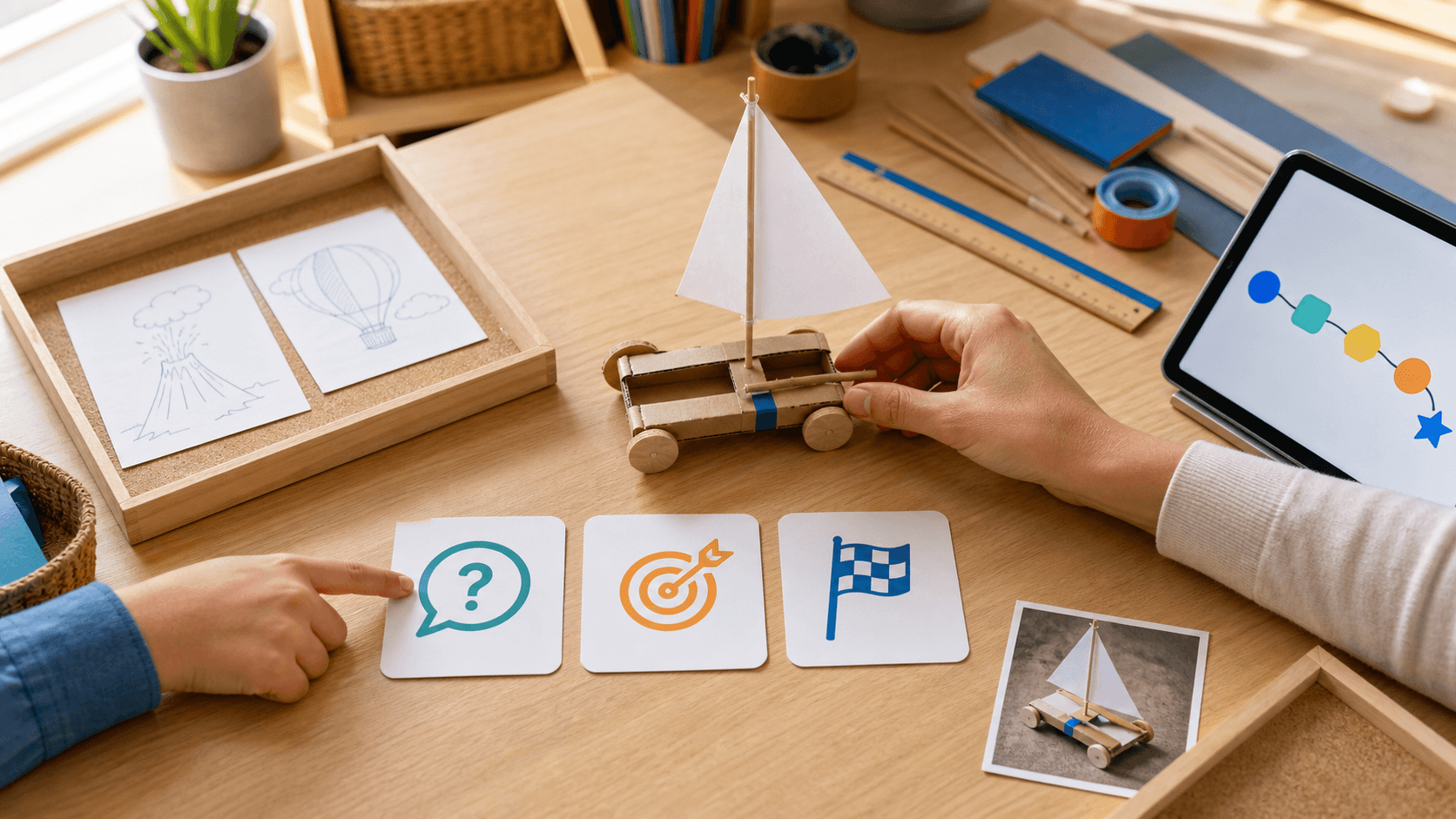
When a child finishes quickly, acceleration can seem like the obvious answer: open the next book, add a harder worksheet, or move into the next grade level. Sometimes that is right. But fast completion can also be an invitation to go deeper before going further.
Use one idea the child already understands and add three depth moves. First, ask a better question: what changes, what stays the same, or why might this pattern exist? Second, try a transfer: measure it, build it, draw it, find it outdoors, or explain it with a different material. Third, pause for a short reflection: what was surprising, difficult, or still open?
For example, a learner who quickly understands a geometric pattern does not need three more copies of the same page. They might build the shape, look for its structure in a shell or leaf, compare two possible rules, and explain which one fits. The activity stays finite; depth is not a demand to turn every interest into a large project.
This approach can also make uneven profiles easier to see. A gifted or high-IQ child may reason far ahead while writing, planning, transitions, attention, or sensory load still need a different kind of support. A twice-exceptional / 2e learner may show a rich idea orally, with objects, or in a sketch before it appears in a long written response. Adjust pace, explanation style, review, sensory load, and challenge without turning learning design into a diagnosis, therapy, cure, or guaranteed outcome.
SchoolQuest AI, part of the Little AI Minds Universe, can hold the structured side of a deeper learning loop: one goal, a parent-visible mission, a mastery check, and a light record of what changed. If a completed SchoolQuest learning thread naturally grows into a creative model, illustrated explanation, or original story, the SchoolQuest AI + Little AI Minds family bundle gives that broader project a home after the core learning decision is clear.
Try one small rule this week: before opening the next level, choose one question, one transfer, and one reflection. If the child still wants to move on after that, acceleration becomes a considered next step rather than the only sign of challenge.
Next decision
Adult learning guide
Creating an adult account is free. Prepared paid practice requires an active SchoolQuest plan; a free account alone does not unlock it.
Adult learning guide
The app offers exercises compatible with the chosen grade and cycles through the selected skill. Prepared explanations and answer feedback help with practice; open written work may need an adult to review it.
Adult learning guidePrepared curriculum
These figures describe the authored curriculum catalogue. The local app offers its compatible prepared exercises; catalogue totals are not a promise of cloud tutoring, certification or every former feature.
Prepared curriculumOther apps have separate scope
These SchoolQuest plans pay for the local SchoolQuest practice described here. They do not create a combined subscription or promise features from Little AI Minds or another app. Check any other app’s current scope and terms separately before buying.
Other apps have separate scopePlans and scope
Creating an adult account is free. Prepared paid practice requires an active SchoolQuest plan; a free account alone does not unlock it.
See prices and orderBrowser app on your device
The app works in a compatible browser. Installing a home-screen shortcut does not add cloud sync or guarantee offline access. Online authentication and parent checks are still required.
Read the device guideAdult learning guide
Contact support
This guide is already public. If you submit the optional form, your adult email, consent and app-interest choice are sent online and stored for that request. Do not include child details. Learning-place JSON backups remain separate.